

Project information
Project location
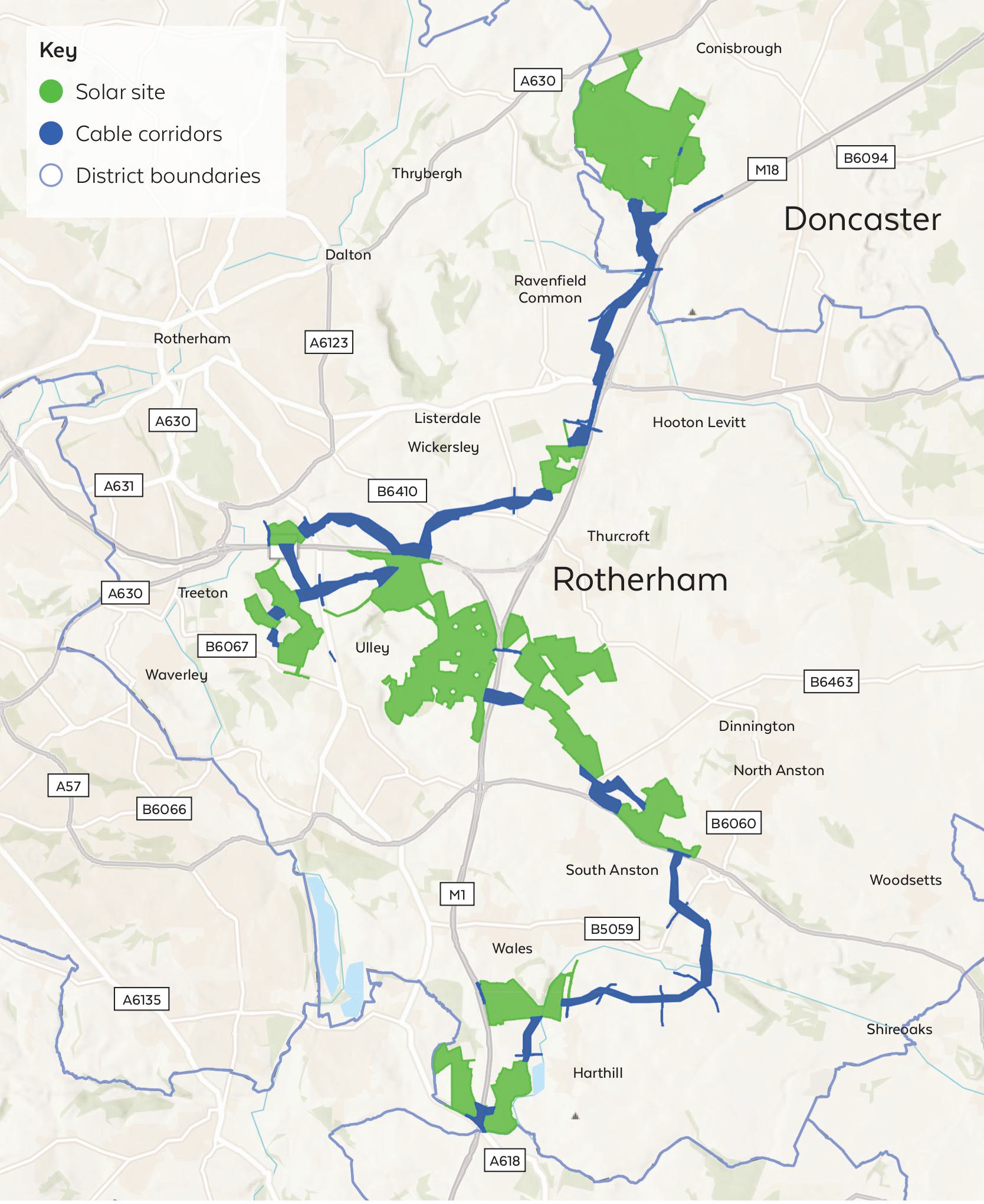
Whitestone is a proposed solar farm that would be located in South Yorkshire, between Rotherham and Doncaster. The project is located across three sections, Whitestone 1 in the north near Conisbrough, Whitestone 2 in the centre around Ulley, and Whitestone 3, in the south near Harthill and Woodall.
Underground cables would connect the three sections of the project together and into the new National Grid substation near Brinsworth on Long Lane. The electricity would enter the National Grid and power up to 250,000 homes across the UK.
The map to the right shows the ‘solar site’ in green. These areas would include solar panels and other infrastructure as well as the areas set aside for wildlife. The final project includes 691 hectares (1,707 acres) of solar areas and other above ground infrastructure, as well as 458 hectares (1,132 acres) of areas set aside for wildlife.
The areas shown in blue are for the underground cables and access roads. After construction, these cables would be not be visible and normal activities could continue above them. There are 339 hectares (837 acres) for the search corridors for the underground cable routes, however this number will decrease significantly as we reduce these search corridors and identify the final locations for the cables.
Interactive Map
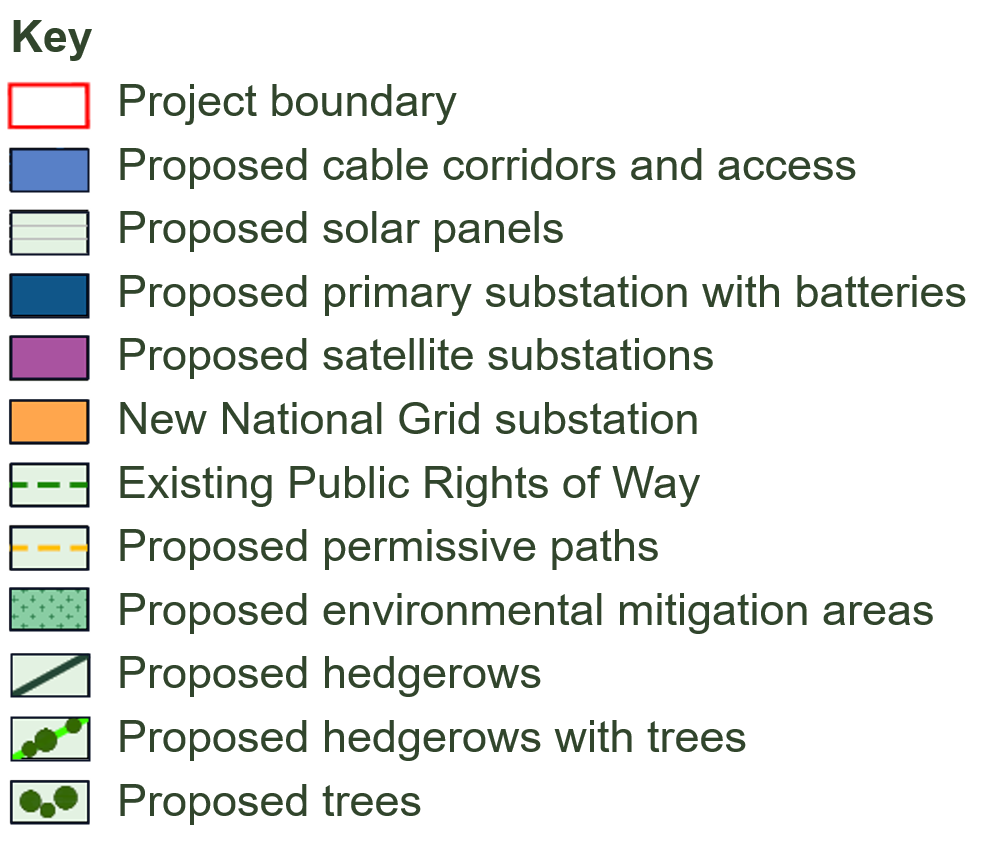
The map to the right shows the project as a whole. You can zoom in to see the detailed masterplans at each of the solar areas.
The masterplans show the locations for technical components, including solar panels, substations, and batteries.
The masterplans also show areas set aside for wildlife and environmental mitigation. These areas would be planted with a mix of native grasses and wildflowers to protect native wildlife and increase biodiversity. Proposed landscaping, including new trees and hedgerows, is included to help mitigate potential visual impacts, while creating new habitats for wildlife.
The updated masterplans also include 14.5km of new permissive paths, shown in the dashed yellow lines, which would help increase access and formalise existing permissive paths across the site.
Click here to view the updated masterplan as a pdf.
Project Development
We have held two rounds on consultation on our proposals for Whitestone. Feedback from these consultations as well as the results of environmental and technical assessments have resulted in significant changes to the project design. Read on to learn more about how each component of the design has evolved in response to consultation feedback and environmental assessments.
Solar areas
We presented our initial proposals in Autumn 2024 during the first consultation. This original masterplan presented all of the land that we were considering to include in the project and those areas that could be used for solar panels and other infrastructure, known as the ‘developable area’ . In response to feedback from that consultation, we reduced these areas by a quarter to create offsets around homes, villages and public rights of way. After the second consultation in Autumn 2025, we responded to feedback and further reduced these areas around homes, villages, and environmentally sensitive locations. The remaining developable area is now 37% smaller than the original proposals.
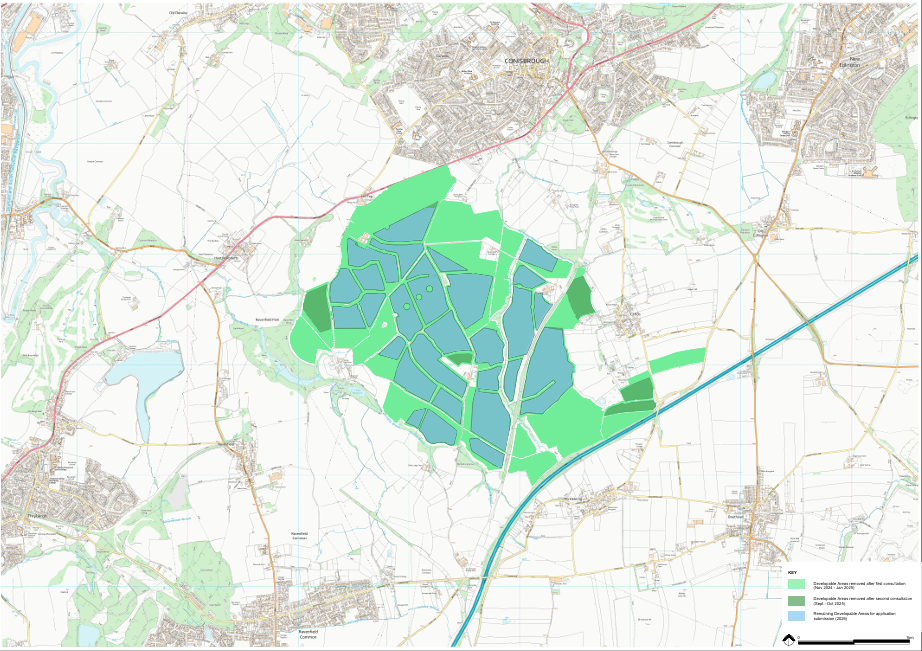
This map shows how the developable area has reduced over time in response to feedback. The total developable area is now 37% smaller than the initial masterplan.
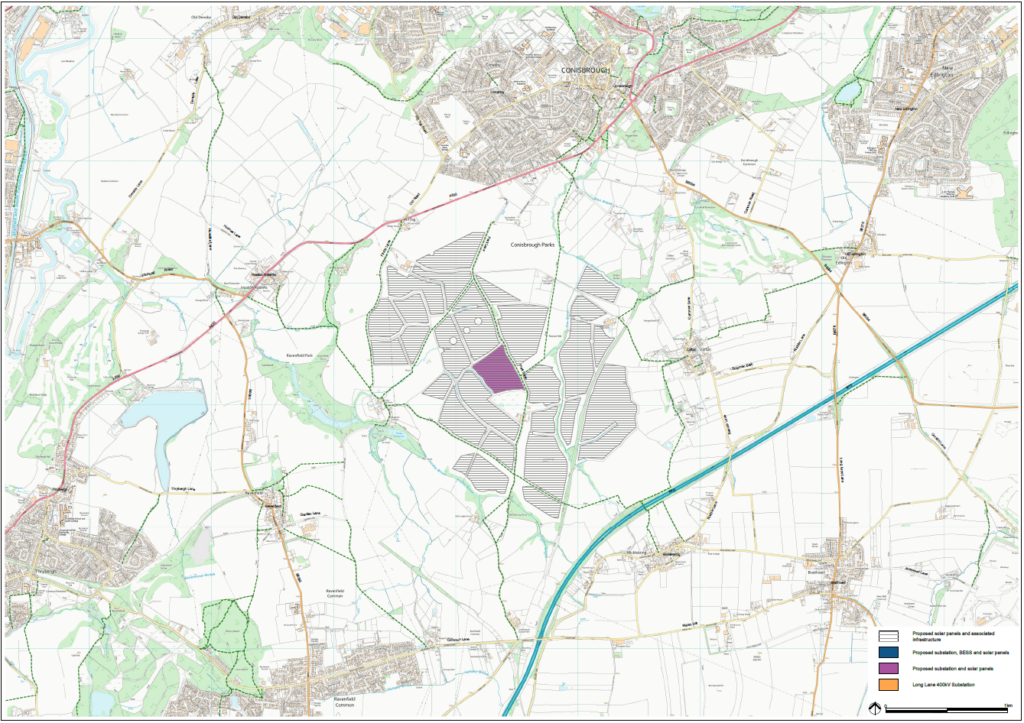
This map shows the remaining developable area.
Green spaces
In addition to the technical components, a well-designed solar farm includes green spaces to support wildlife, protect views and enable recreation. In the areas with solar panels, fields would be planted with native grasses, supporting a diverse ecosystem that can thrive between and beneath the panels. There are also areas without any above-ground infrastructure that would be used for ‘environmental mitigation and enhancement’. These areas would be planted with a mix of native species, including grasses and wildflowers to support local wildlife and increase biodiversity. These spaces would help reduce potential impacts by creating offsets away from key locations, including homes, villages, public rights of way and other environmentally sensitive locations.
After the first consultation, we removed one quarter of the solar areas but left these areas within the project’s boundary for environmental mitigation and enhancement. During the second consultation, we heard from communities their concerns about potential impacts on agricultural production and agricultural jobs. Therefore, we reviewed all of these areas to determine if they were necessary. Wherever possible, any areas considered unnecessary have now been removed from the project and will continue under their current land use to maximise agricultural production. The remaining solar areas will be suitable for grazing sheep, which we will continue to explore as the project progresses.
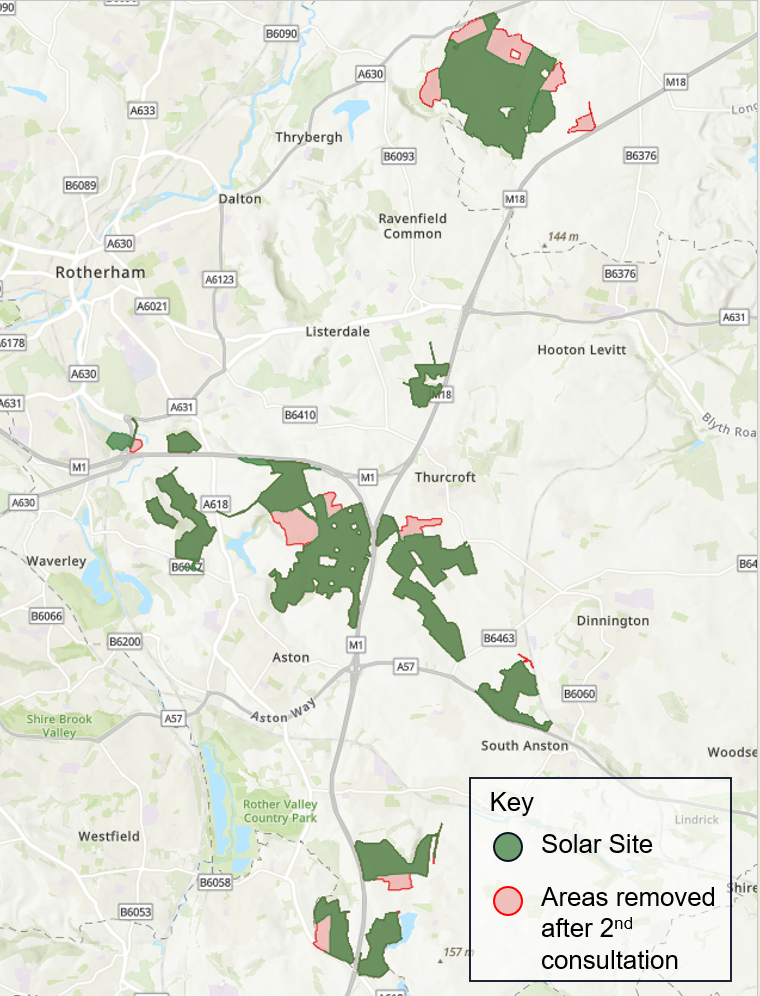
This map shows the areas that have been removed from the project after the second consultation.
Cable routes
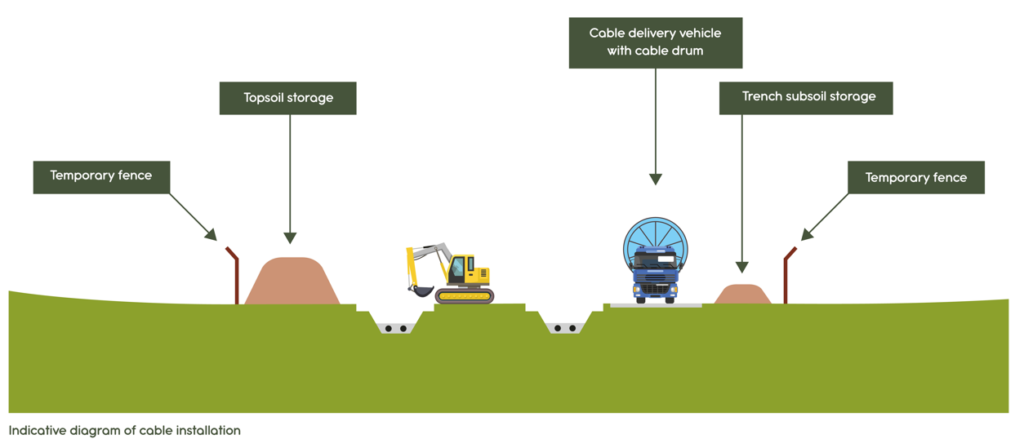
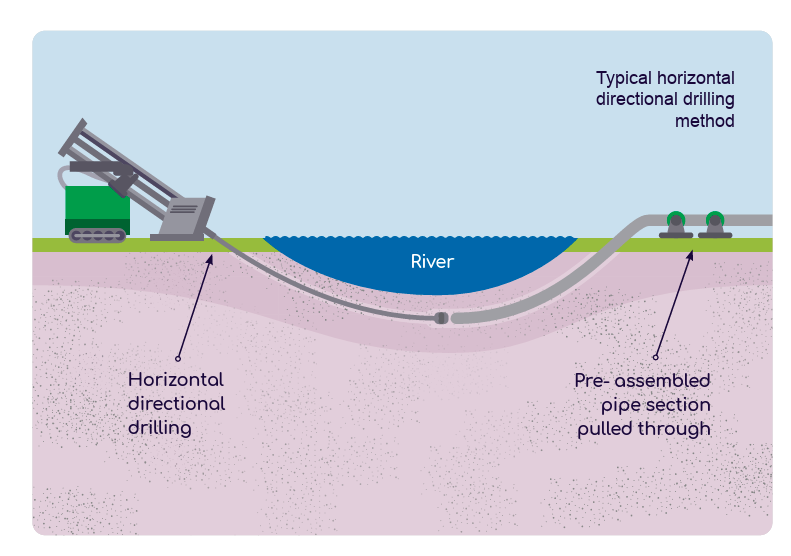
Underground cables are needed to connect the solar areas together and into the National Grid substation. Most cables could be laid through open trenches, where the cable is laid approximately 1m below the ground level, and then soil is replaced on top. Through more sensitive areas, such as woodlands, highways, or streams, we may need to use trenchless crossing methods, such as Horizontal Directional Drilling (HDD), which drills under the sensitive area and pulls the cable through.
During the second consultation, we were able to present options for the cable corridors that would be needed to connect the solar areas together and into the National Grid substation. These potential locations had been identified through environmental and technical assessments, and have now been refined in response to feedback from the consultation. We are now able to present the final locations for these cable corridors. Please note that the cable will only need a small area within the cable corridor that is indicated.
Substations and Batteries
In addition to the solar panels, the project would need three substations to collect the electricity, increase its voltage, and prepare it to connect into the National Grid. The project would also include a battery energy storage system that would store the energy after it is produced, and release it to the grid when it is needed most.
During the second consultation, we presented the potential locations where the substations and batteries could be located. These potential locations had been identified through environmental and technical assessments, and have now been refined in response to feedback from the consultation. We are now able to present the final locations for these components. There would be one substation in the centre of Whitestone 1, one substation in the southeastern portion of Whitestone 2, and then the main substation with batteries near Brinsworth. There is no substation needed for Whitestone 3. Please note that the substations will not need all of the space within the fields that are indicated.
Hover over the numbers in the graphic to the right to learn more about the technical components of the project.
![WS – Components of a solar farm infographic[88]](https://whitestonesolarfarm.co.uk/wp-content/uploads/2024/11/WS-Components-of-a-solar-farm-infographic88.png "WS – Components of a solar farm infographic[88]")

Why here?
The National Grid connects power users to power sources across the UK, through a network of substations, pylons and cables. New energy projects can only connect into the National Grid at locations where there is available capacity. There was available capacity at Brinsworth, so we were able to secure an agreement for a new energy project to connect at this location. Once we had secured the grid connection agreement, we looked for land nearby that would be suitable for solar. We also wanted to avoid environmentally sensitive areas and the highest quality agricultural land, where possible.
As part of the Great Grid Upgrade, National Grid is proposing a new substation near Brinsworth on Long Lane and new overhead lines to help carry more renewable energy between the North to the Midlands. This project is not related to Whitestone, but they have moved our grid connection to the new location.
While the grid connection is to the Long Lane Substation, this substation is still in planning and has not yet been constructed. Therefore, we have included both substations in the project boundary in case, for any reason the new substation is not constructed.
Why solar?
The UK has committed to eliminating fossil fuels from the power supply, to provide energy security and reduce future energy costs while supporting the fight against climate change. Now that the last coal power station in the UK, Ratcliffe-on-Soar, has been closed down, new renewable energy sources are needed to come forward to keep the lights on. At the same time, our demand for electricity continues to increase and is projected to double by 2050. To meet these future energy needs, we must quickly ramp up production of renewable energy here in the UK.
The Clean Power 2030 mission sets a goal to triple solar capacity by 2030, while also ramping up onshore and offshore wind development. Solar and wind work well together, and a mix of both helps provide stability to the energy supply.
The Solar Roadmap explains how the UK will achieve the Clean Power mission and includes new mechanisms to increase rooftop solar installations. From 2027, most new homes will be required to include solar panels, known as the Future Homes Standard. We support the ‘rooftop revolution’ and continue to explore commercial rooftop installations as part of our broader business, but note that large scale solar developments are needed to produce enough energy to meet our national energy goals.


The Developer
The Proposed Development is being brought forward by Whitestone Net Zero Ltd (owned by Net Zero One Ltd). Net Zero One Ltd is a specialist renewable energy development business, founded in 2021 to ensure there is sufficient funding to build, operate and decommission the Proposed Development and other similar projects.
The overall manager for the project is Green Nation. Established in 2011, Green Nation has been among the leaders in making the energy transition work. It is a UK-based solar developer and manager of operational sites with extensive experience in both rooftop and ground-mounted solar projects. Green Nation currently manages 75 solar farms and more than 700 solar rooftop installations across the country. Its solar farm portfolio totals over 200 MW of electricity producing capacity for the UK.